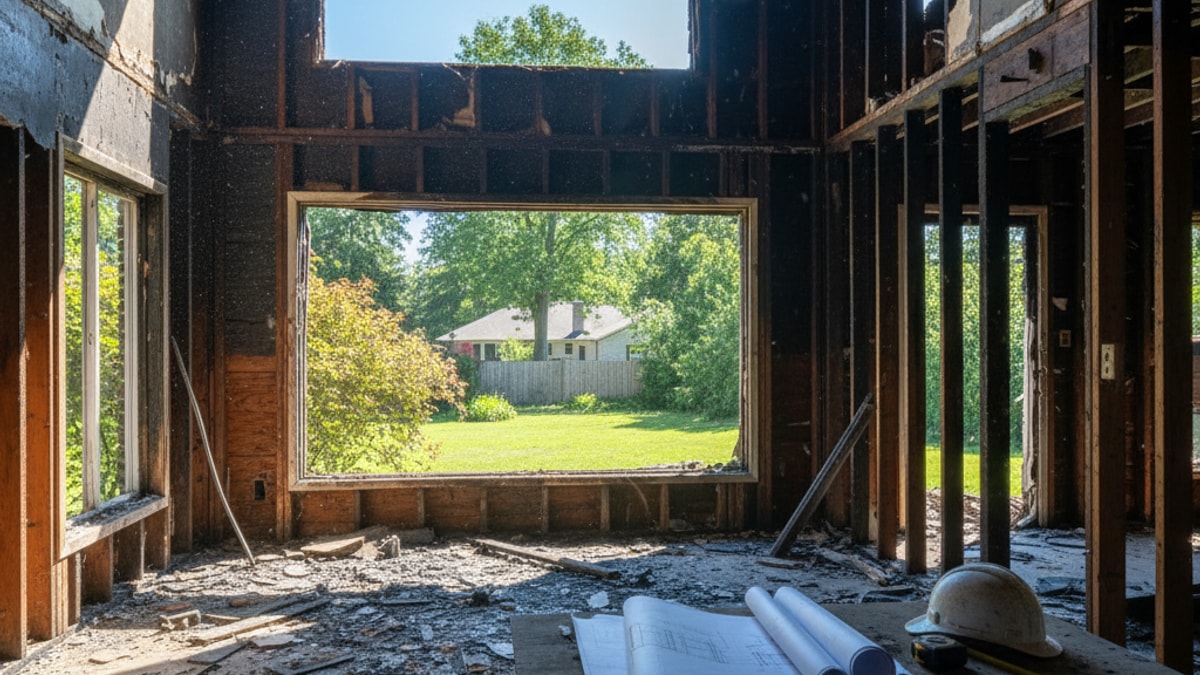
A 2023 analysis of homeowner insurance claims by J.D. Power found that 41% of fire damage claims experienced disputes over payout amounts, and the average claim resolution timeline stretched to 223 days. More than seven months from filing to final payment. What most homeowners don’t realize until they’re already committed: fire damage insurance operates on actual cash value or replacement cost formulas that routinely exclude categories of damage the policy language technically covers, and the gap between estimated payout and actual restoration cost consistently favors the insurer.
Our team has walked hundreds of homeowners through this exact decision. The gap between doing it right and doing it wrong comes down to understanding three things most insurance agents won’t tell you upfront: what your policy actually excludes, how long the dispute process really takes, and what selling as-is delivers that insurance never can.
What happens if I file a fire damage insurance claim versus selling my home as-is?
Filing a fire damage insurance claim triggers a claims adjuster assessment, a repair estimate subject to depreciation and coverage exclusions, and a payout timeline of 4–8 months assuming no disputes. Selling as-is to a direct buyer delivers a cash offer within 7–10 days, closes in 2–4 weeks, and eliminates claim denials, contractor delays, and the risk that your final insurance payout falls short of actual restoration costs by 15–30%.
Here’s the honest answer most homeowners receive too late: fire damage insurance is designed to restore your property to pre-loss condition. But policy language defines that condition through depreciation schedules, coverage caps, and exclusions that reduce your effective payout well below what full restoration actually costs. Teams that file claims without reading the policy’s Section I exclusions consistently discover six months into the process that smoke damage to HVAC systems, mold remediation beyond surface cleaning, or foundation damage from firefighting water aren’t covered at the levels required to make the home livable again. This article covers the specific cost categories most policies exclude, the timeline you’re actually facing when you file, and the three decision points that determine whether insurance or selling as-is delivers better financial outcomes.
Fire Damage Insurance: What Your Policy Actually Covers (and Excludes)
Fire damage policies operate on two valuation methods: actual cash value (ACV) and replacement cost value (RCV). ACV pays the depreciated value of damaged items. A 10-year-old roof destroyed by fire receives a payout based on its current depreciated worth, not the cost to install a new roof. RCV pays the cost to replace items with new equivalents. But most policies require you to complete the repairs before releasing the full replacement cost amount. The gap between these two formulas routinely reaches 20–35% of the total claim value.
Policy exclusions matter more than coverage statements. Standard homeowner policies exclude or limit: gradual damage (smoke infiltration into drywall that occurs over hours, not minutes), consequential damage (mold growth from firefighting water if more than 72 hours pass before remediation starts), code upgrade costs (bringing electrical or structural systems up to current building codes if the original installation was grandfathered), and secondary perils like foundation settling caused by water saturation during firefighting. These exclusions don’t appear in the coverage summary. They’re buried in Section I exclusions and definitions, and most homeowners don’t read them until the adjuster cites them during payout negotiation.
The deductible applies to the entire claim, not per category. A $2,500 deductible on a $75,000 fire damage claim reduces your net payout to $72,500. But if the adjuster disputes $15,000 of the claim as excluded or depreciated damage, your net drops to $57,500 before you’ve hired a single contractor. Depreciation schedules vary by item category: roofing depreciates at 5–10% per year, flooring at 10–15%, appliances at 20% annually. A home with 15-year-old systems can see depreciation reduce the gross payout by $20,000–$30,000 before exclusions are applied.
Selling After Fire Damage: How Cash Buyers Price As-Is Offers
Direct buyers price fire-damaged homes using after-repair value (ARV) minus estimated restoration cost minus a profit margin of 15–25%. ARV is determined by comparable sales of similar homes in move-in condition within 0.5 miles sold in the past 90 days. Restoration cost is bid by licensed contractors the buyer works with regularly. Not inflated retail quotes. The profit margin compensates the buyer for carrying costs (loan interest, taxes, insurance during the 3–6 month repair period), transaction costs (closing costs, holding costs, resale commission), and project risk (cost overruns, timeline delays, permit issues).
A fire-damaged home with an ARV of $350,000 and restoration costs estimated at $80,000 typically receives offers in the $220,000–$245,000 range from cash buyers. The $25,000 variance reflects different buyers’ risk tolerance, access to lower-cost labor, and required profit margins. Buyers who self-perform some restoration work or hold contractor licenses can offer higher because their carrying costs and margins are lower. National iBuyer platforms typically offer 5–10% less than local investors because they price algorithmically and outsource all repairs at retail contractor rates.
The as-is sale eliminates costs the insurance route doesn’t: no interim housing while repairs occur (3–6 months at $2,000–$3,500/month), no project management time coordinating contractors and inspectors, no risk that the insurance payout falls short and you’re forced to cover the gap out of pocket, and no secondary damage from delayed repairs (mold, structural deterioration, vandalism of a vacant property). These avoided costs offset some of the discount inherent in as-is pricing. The net financial difference between insurance and selling as-is is often narrower than the gross numbers suggest.
Fire Damage Insurance vs Sell: Full Cost Comparison
| Factor | Insurance Claim Route | Sell As-Is Route | Net Financial Impact | Timeline | Professional Assessment |
|---|---|---|---|---|---|
| Payout/Offer Amount | Policy limit minus deductible minus depreciation minus exclusions | ARV minus restoration cost minus 15–25% profit margin | Insurance: $60K–$75K (typical). Sell: $220K–$245K (typical ARV $350K, repairs $80K) | Insurance: 4–8 months to payout. Sell: 2–4 weeks to close | Insurance delivers higher gross if claim is approved without disputes and depreciation is minimal. Selling delivers certainty and eliminates dispute risk. |
| Out-of-Pocket Costs | Deductible ($1K–$5K), interim housing ($6K–$21K for 3–6 months), contractor cost overruns if payout is insufficient | None. Buyer assumes all repair costs | Insurance adds $7K–$26K unavoidable costs. Selling: $0 additional outlay | Insurance costs accrue during 3–8 month claim-to-repair period. Selling: costs end at close | Selling eliminates all post-transaction financial exposure. Insurance transfers repair cost but not project risk. |
| Dispute/Delay Risk | 41% of claims disputed (J.D. Power 2023). Average resolution: 223 days. Exclusions discovered mid-process | No disputes. Offer is binding at acceptance | Insurance: high probability of 2–6 month delay beyond initial estimate. Selling: zero dispute risk post-acceptance | Insurance delays are common and unpredictable. Selling timelines are contractual | Dispute probability and timeline uncertainty make insurance the higher-risk path for homeowners needing liquidity or finality. |
| Contractor Management | Homeowner selects contractors, manages bids, oversees work, handles permit issues, coordinates inspections | Buyer assumes all contractor relationships and project risk | Insurance requires 40–80 hours homeowner time coordinating repairs. Selling: zero time requirement | Insurance: 3–6 months active project management. Selling: zero post-close involvement | Selling transfers the single largest non-financial burden. Project management of a complex restoration with municipal permitting and inspection requirements. |
| Tax Treatment | Insurance payouts for primary residence damage are not taxable income if used for repairs | Sale proceeds may trigger capital gains if home has appreciated beyond $250K (single)/$500K (married) exclusion | Insurance: $0 tax liability. Selling: potential capital gains on appreciation above exclusion threshold (rare for fire-damaged homes sold at discount) | Tax impact realized in year of transaction for both routes | Most fire-damaged homes sold as-is don’t trigger capital gains because sale price after discount falls below original purchase price plus improvements. Consult a CPA before assuming tax neutrality. |
Key Takeaways
- Fire damage insurance claims average 223 days to final payout, with 41% experiencing disputes over excluded damage or depreciation amounts that reduce net proceeds by 15–30%.
- Selling as-is eliminates interim housing costs ($6,000–$21,000), contractor management time (40–80 hours), and the risk that insurance payout falls short of actual restoration costs.
- Cash buyer offers are calculated as after-repair value minus restoration cost minus 15–25% margin. A $350,000 ARV home with $80,000 in repairs typically nets $220,000–$245,000.
- Policy exclusions for smoke infiltration, mold beyond 72 hours, code upgrades, and consequential damage reduce effective coverage by $15,000–$40,000 on most residential fire claims.
- Depreciation schedules subtract 5–20% annually depending on item category. 15-year-old systems can lose $20,000–$30,000 in claim value before exclusions are applied.
- The financial gap between insurance net payout and as-is sale proceeds is often 10–20% once avoided costs (housing, time, dispute risk) are factored into the comparison.
What If: Fire Damage Insurance vs Sell Scenarios
What If My Insurance Adjuster Says the Damage Isn’t Covered Under My Policy?
Request the specific policy section and exclusion language in writing. Adjusters citing verbal denials without documented policy references are often negotiating, not interpreting binding contract terms. Hire a public adjuster (licensed claim advocates who work for homeowners, not insurers) to review the denial and file a formal dispute if the exclusion claim is incorrect. Public adjusters charge 5–15% of the final settlement but increase claim payouts by an average of 30–40% according to state insurance department data. If the denial is valid and appeal is unlikely to succeed, selling as-is becomes the faster path to liquidity. Cash offers don’t require coverage disputes or policy interpretation.
What If I’ve Already Started the Insurance Claim Process — Can I Still Sell As-Is Instead?
Yes. You can withdraw an insurance claim at any point before accepting the payout, though the claim will remain on your property’s CLUE report (Comprehensive Loss Underwriting Exchange) for seven years. Selling with an open claim requires disclosure to the buyer, and most cash buyers will require you to formally withdraw the claim and sign an affidavit that no insurance proceeds were received for the damage they’re purchasing. Starting a claim and then selling doesn’t disqualify you from selling as-is, but it does create a disclosure requirement that affects offer amounts if the buyer perceives claim withdrawal as a red flag about damage severity.
What If the Fire Damage Is Minor — Is Insurance Always the Better Option for Small Claims?
Not necessarily. Filing a claim for damage below $10,000 can increase your premiums by 20–40% annually for the next 3–5 years, and the claim appears on your CLUE report even if the payout is minimal. A $6,000 payout on a kitchen fire with a $2,500 deductible nets you $3,500. But if your annual premium increases from $1,800 to $2,400 for four years, you’ve paid $2,400 in additional premiums to net $3,500, leaving a true gain of $1,100 spread over four years. For claims under $15,000, compare the net payout after deductible against the present value of five years of premium increases before filing. Paying out of pocket or selling as-is often delivers better long-term economics.
The Unflinching Truth About Fire Damage Insurance vs Selling
Here’s the bottom line: fire damage insurance is a hedge against catastrophic total loss. Not a project financing tool for complex restorations with disputed coverage categories. The policy was never designed to make you whole in the sense of delivering a check equal to retail restoration cost. It was designed to indemnify you for covered losses at depreciated value, with enough exclusions and conditions that the insurer’s payout obligation stays structurally below the retail cost to restore. Homeowners who file claims expecting a turnkey repair budget consistently discover that the policy caps, depreciation schedules, and exclusion clauses reduce their net position by 20–40% compared to what they assumed ‘full coverage’ meant.
Selling as-is to a cash buyer isn’t settling for less. It’s exchanging one set of discounts (the buyer’s profit margin) for another (the insurer’s depreciation and exclusions), and in return you eliminate dispute risk, project management burden, and the six-month gap between filing and payout. The decision isn’t binary. Some homeowners should file claims, others should sell immediately, and many should do both (file the claim to preserve the option, get cash offers simultaneously, then choose whichever path delivers better net proceeds once the adjuster’s estimate is final). What doesn’t work is assuming the insurance path is automatic without reading the policy exclusions, calculating net payout after depreciation and deductible, and pricing the avoided costs that selling as-is delivers.
If the numbers are close. And they often are once interim housing, contractor risk, and dispute probability are priced in. Speed and certainty tip the scale. A cash offer you can close in three weeks and walk away from eliminates the single largest source of stress in fire damage recovery: the uncertainty of whether the insurance company will pay what you need, when you need it, without a fight. That certainty has a dollar value. And for many homeowners, it’s worth more than the 10–15% gross difference between claim payout and as-is offer.
Our team at Home Helpers works with homeowners navigating exactly this decision every month. We’ve seen claims pay out in full with zero disputes, and we’ve seen claims drag on for 18 months with three rounds of adjuster revisions and a final payout 40% below the initial estimate. The pattern that separates good outcomes from bad is this: homeowners who understand their policy exclusions, calculate net payout after all deductions, and price the value of certainty make informed decisions. Those who assume ‘full coverage’ means full restoration cost without reading Section I exclusions consistently regret filing six months later when the payout lands and the gap becomes real.
Frequently Asked Questions
How long does a fire damage insurance claim typically take from filing to final payout?
The average fire damage insurance claim takes 4–8 months from initial filing to final payout if there are no disputes, but J.D. Power’s 2023 analysis found that 41% of claims experience disputes over coverage exclusions or depreciation, extending the timeline to an average of 223 days (more than seven months). Complex claims involving structural damage, mold, or code upgrade requirements can stretch to 12–18 months if multiple rounds of adjuster review and contractor re-estimates are required.
Can I sell my fire-damaged home while an insurance claim is still pending?
Yes, but you must disclose the open claim to the buyer, and most cash buyers will require you to formally withdraw the claim before closing and sign an affidavit confirming no insurance proceeds were received for the damage. The withdrawn claim remains on your property’s CLUE report for seven years, which can affect the buyer’s offer amount if they view the claim history as a signal of undisclosed damage severity. Selling with an active claim is legal but creates disclosure and documentation requirements that affect transaction complexity.
What fire damage costs does homeowner insurance typically not cover?
Standard homeowner policies exclude or limit coverage for: smoke infiltration into porous materials like drywall that occurs gradually rather than instantly, mold remediation if more than 72 hours pass between water exposure and treatment, code upgrade costs to bring electrical or structural systems to current standards, consequential damage like foundation settling from firefighting water saturation, and depreciation on items over five years old (which reduces payout by 5–20% annually depending on category). These exclusions routinely reduce net claim payouts by 15–30% compared to full retail restoration cost.
How do cash buyers calculate offers on fire-damaged homes?
Cash buyers use this formula: after-repair value (ARV based on comparable sales of similar homes in move-in condition) minus estimated restoration cost (bid by licensed contractors) minus profit margin of 15–25%. A home with $350,000 ARV and $80,000 in fire damage repairs typically receives offers of $220,000–$245,000. The profit margin compensates for carrying costs during the 3–6 month repair period, transaction costs, and project risk including cost overruns and permit delays.
Is filing a fire damage insurance claim worth it for damage under $15,000?
Not always — filing a claim for damage under $10,000–$15,000 can increase your annual premiums by 20–40% for the next 3–5 years, and the claim appears on your CLUE report even if the payout is small. A $6,000 payout with a $2,500 deductible nets $3,500, but if your premium rises from $1,800 to $2,400 annually for four years, you pay $2,400 in additional premiums over that period, leaving a net gain of only $1,100. For minor claims, compare net payout after deductible against the present value of five years of premium increases before filing.
What happens if my fire damage insurance payout is less than the actual repair cost?
If the insurance payout falls short of restoration cost, you have three options: pay the difference out of pocket to complete repairs, negotiate with contractors to reduce scope or find lower-cost alternatives, or sell the home as-is and let the buyer handle the shortfall. Policies based on actual cash value (depreciated value) rather than replacement cost routinely create a 20–35% gap between payout and actual repair cost, and homeowners who don’t have reserves to cover that gap often discover the shortfall only after contractors begin work and realize the payout is insufficient.
Do I need to disclose fire damage if I sell my home as-is to a cash buyer?
Yes — all states require sellers to disclose known material defects including fire damage, even in as-is sales. Material defects are conditions that significantly affect property value or habitability, and fire damage always qualifies. Failure to disclose can result in post-sale litigation, rescission of the sale, or fraud claims. Cash buyers expect full disclosure and will conduct their own inspections, but intentionally concealing fire damage to secure a higher offer creates legal liability that persists after closing.
How does selling a fire-damaged home affect my capital gains tax liability?
Fire-damaged homes sold at a significant discount rarely trigger capital gains tax because the sale price typically falls below the original purchase price plus improvements, keeping the transaction within the $250,000 (single) or $500,000 (married) primary residence exclusion. However, if you’ve depreciated the property as a rental or claimed prior casualty loss deductions, depreciation recapture rules may apply. Consult a CPA before assuming tax neutrality — each situation is fact-specific based on your cost basis, holding period, and prior tax treatments.
What is the difference between actual cash value and replacement cost value in fire damage claims?
Actual cash value (ACV) pays the depreciated current worth of damaged items — a 10-year-old roof receives a payout based on its depreciated value, not the cost of a new roof. Replacement cost value (RCV) pays the cost to replace items with new equivalents, but most policies require you to complete repairs before releasing the full RCV amount. The gap between ACV and RCV typically reaches 20–35% of the total claim value, and homeowners who don’t understand which formula their policy uses consistently overestimate their net payout.
Can I negotiate a fire damage insurance payout if I disagree with the adjuster’s estimate?
Yes — you can hire a public adjuster (a licensed professional who advocates for policyholders, not insurers) to review the claim and negotiate with the insurance company. Public adjusters charge 5–15% of the final settlement but increase payouts by an average of 30–40% according to state insurance department data. You can also request a second independent appraisal under most policy terms, though this requires both parties to agree on the appraiser selection process. Disputing a payout extends the timeline by 2–6 months but can recover $10,000–$40,000 in previously excluded or undervalued damage.
