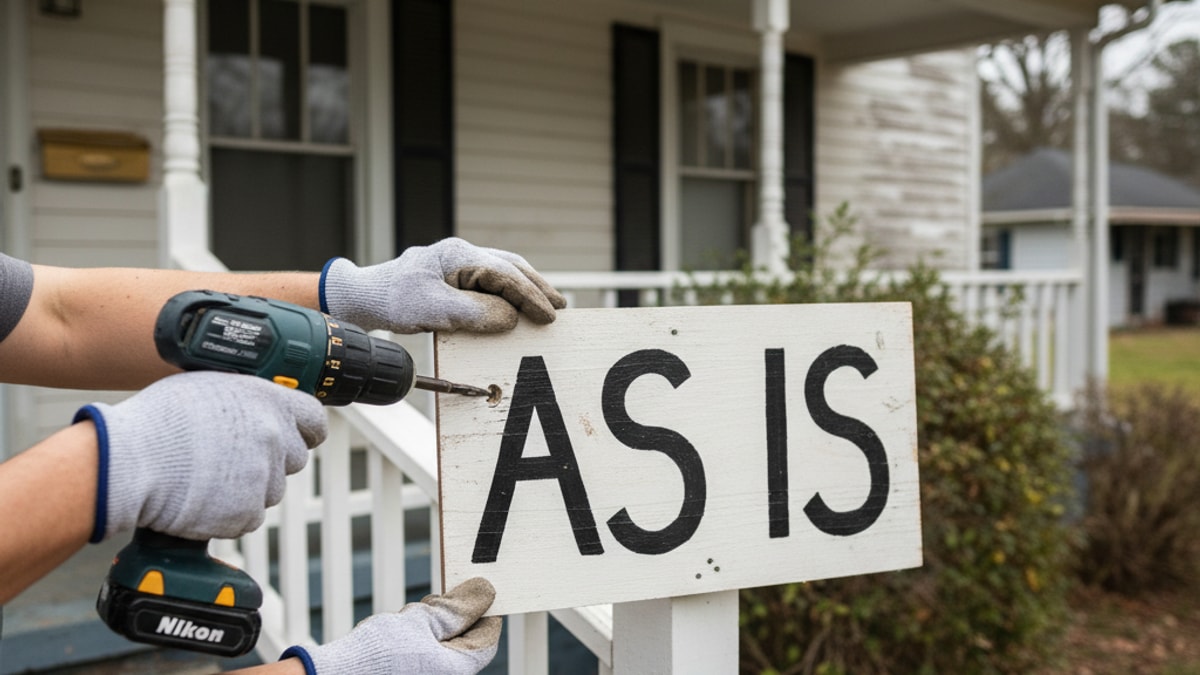
It’s a question our team hears almost every day, often whispered with a mix of anxiety and hope: “How do you sell a house as is?” Maybe you’ve inherited a property that’s a time capsule from another era, complete with shag carpeting and avocado-green appliances. Perhaps life threw a curveball—a sudden job relocation, a difficult divorce, or mounting financial pressure—and the time, money, and emotional energy required for a full-scale renovation just aren’t there. Or maybe, the house simply has what we in the industry call “good bones” but a very tired everything else.
Whatever your story, the idea of selling “as is” can feel like a lifeline. It promises a path forward without the daunting parade of contractors, the endless dust of demolition, and the formidable expense of modernizing a property for today’s demanding Los Angeles buyers. But it’s also a term shrouded in misconceptions. Our experience shows that many sellers aren’t entirely sure what it entails, what their obligations are, or what it truly means for their bottom line. We’re here to pull back the curtain and give you an unflinching, honest look at the entire process—the good, the challenging, and the genuinely strategic.
What “Selling As Is” Actually Means (And What It Doesn’t)
First, let’s clear the air. Selling a house “as is” is a legal term, but its common interpretation is often a bit fuzzy. It essentially means you, the seller, are not willing to perform any repairs, offer any credits, or make any improvements to the property before closing. The buyer is agreeing to take the property in its current condition, warts and all.
It’s a declaration. A line in the sand. You’re telling the market: what you see is what you get.
Dispelling the Myths
Here’s where things get tricky. Many sellers mistakenly believe “as is” is a magic shield that protects them from all responsibility. It’s not. Our team has seen this misunderstanding lead to serious legal trouble. Let’s be perfectly clear on a few points:
- It Does NOT Mean You Can Hide Problems: This is the big one. We can’t stress this enough. Selling “as is” never, ever absolves you of your legal duty to disclose known material defects. If you know the foundation has a crack, the roof leaks during heavy rains, or there’s a history of plumbing backups, you are legally obligated to tell potential buyers. Hiding a known issue is fraud, and an “as is” clause won’t protect you from a lawsuit after the sale.
- It Does NOT Mean Buyers Can’t Inspect: A buyer purchasing an “as is” home still has the right—and frankly, should be encouraged—to conduct a thorough home inspection. The difference is what happens after the inspection. Instead of presenting you with a laundry list of repair requests, their decision is typically binary: they either move forward with the purchase, accepting the issues uncovered, or they walk away (usually if their contract allows for an inspection contingency).
- It Does NOT Mean Your House is Unsellable: Far from it. In a competitive market like Los Angeles, there’s a buyer for almost every property. The key is finding the right kind of buyer—someone who sees potential where others see problems. This could be a flipper, an investor, or even a traditional homebuyer with the resources and vision to take on a project.
The Legal Realities: Disclosure is Non-Negotiable
In California, the seller’s disclosure obligations are robust. You’ll be required to fill out a Transfer Disclosure Statement (TDS) and other related forms, detailing everything you know about the property’s condition. Honesty here is not just the best policy; it’s the law. Our team always advises sellers to be over-inclusive in their disclosures. Think about it from a risk-management perspective: disclosing a minor, historical leak that was fixed years ago is far better than having a buyer discover evidence of it later and claim you hid a water damage problem. It builds trust and protects you in the long run.
This is where having an experienced partner becomes a critical, non-negotiable element of the process. Understanding the nuances of what constitutes a “material defect” and how to properly document it can save you from catastrophic headaches down the road.
Why Would You Sell a House As Is? The Real-Life Scenarios
The decision to sell a home without making repairs isn’t born from laziness. It’s almost always a practical response to a specific set of life circumstances. We’ve worked with hundreds of homeowners across Southern California, and the reasons are as diverse as the properties themselves.
Inherited Property Overwhelm
This is a classic scenario. You and your siblings inherit your parents’ home, a place filled with memories but also deferred maintenance. You live hours away, you have your own grueling road warrior hustle, and the idea of managing a long-distance renovation is simply a non-starter. The emotional toll of clearing out a lifetime of belongings is already a formidable task; adding a kitchen remodel on top of it is just too much. Selling “as is” provides a clean, simple solution for the estate to liquidate the asset and distribute the proceeds without the logistical nightmare.
Financial Distress or Urgent Relocation
Sometimes, life moves faster than you can keep up. A sudden job offer in another state, an unexpected medical situation, or the threat of foreclosure can create immense pressure to sell quickly. In these cases, the funds for a new roof or an updated electrical panel simply don’t exist. The priority isn’t maximizing every last dollar of potential profit; it’s achieving a certain, fast, and reliable sale. Selling “as is” directly to a cash buyer like Home can provide that speed and certainty when it’s needed most.
And—let’s be honest—this is crucial. When time is the most valuable commodity you have, the traditional market’s timeline can feel like an eternity.
Major Structural or Cosmetic Damage
The house has “issues.” Big ones. It could be a foundation problem that requires thousands in engineering and repair work. It could be extensive termite damage that has compromised structural integrity. Or maybe it’s just cosmetically trashed after years of neglect or a tenant who was less than careful. For many homeowners, the cost and complexity of these repairs are simply out of reach. An “as is” sale targets buyers who have the capital and expertise to tackle these significant projects—buyers who are specifically looking for this type of opportunity and price it accordingly.
The Two Main Paths: The Traditional Market vs. A Direct Cash Sale
Okay, so you’ve decided selling “as is” is the right move for you. Now, how do you actually do it? Your journey will almost certainly go down one of two very different paths. Each has its own distinct set of pros, cons, and expectations.
Path 1: Listing “As Is” on the Multiple Listing Service (MLS)
This is the conventional route. You hire a real estate agent, they list your property on the MLS, and you market it to the general public with the clear designation that it’s being sold in its present condition. The potential upside here is exposure. You’re casting the widest possible net, hoping to attract a range of buyers and potentially spark a bidding war.
However, this path is fraught with challenges. The pool of qualified, interested buyers for a fixer-upper is dramatically smaller than for a turnkey home. Many traditional buyers are financed through FHA or VA loans, which have strict minimum property standards. A leaky roof, peeling paint, or a non-functional HVAC system could easily disqualify your home from these types of financing, shrinking your buyer pool even further. You’ll also have to deal with the constant parade of showings, open houses, and the uncertainty of a buyer’s financing falling through. Our team has found that even when listed “as is,” buyers on the open market will still often try to negotiate for repairs or credits after their inspection, creating a frustrating, drawn-out process.
It can work. But it requires patience and a thick skin.
Path 2: Selling Directly to a Cash Home Buyer (Like Us)
This is the alternative path, one that prioritizes speed, certainty, and convenience over absolute top-dollar. Companies like ours specialize in buying properties directly from homeowners for cash. We are the buyers. There are no agents, no listings, no showings, and no waiting for mortgage approvals.
Because we buy with cash and have our own construction crews, the condition of your home is not an obstacle. In fact, it’s our business model. We look for properties where we can add value through repairs and renovations. This allows us to make you a firm, no-obligation cash offer and close on your timeline—sometimes in as little as a week. You don’t have to clean, you don’t have to repair, and you don’t have to worry about a deal falling apart because of a bad inspection report. It’s a significant, sometimes dramatic shift in the selling experience.
The trade-off, of course, is price. A cash offer will almost always be lower than the potential top-end price you might get on the open market after months of waiting. But when you factor in the saved repair costs, the lack of commissions (which can be 5-6%), and the holding costs you avoid (mortgage, taxes, insurance for months), the net difference is often much smaller than people assume. It all comes down to what you value more: a potentially higher price with significant uncertainty and hassle, or a fair, certain price with unparalleled speed and ease. We’ve found that for many sellers in the situations described above, the second option is a godsend. You can learn more about our specific approach and team on our About page.
Here’s a simple breakdown of the two approaches:
| Feature | Listing “As Is” on the MLS | Selling Directly to a Cash Buyer |
|---|---|---|
| Sale Price | Potentially higher, but not guaranteed | A fair cash offer, lower than retail |
| Speed | Slow (typically 60-90+ days) | Fast (as little as 7-10 days) |
| Certainty | Low (deals fall through due to financing/inspections) | High (cash offers are firm, no financing contingency) |
| Repairs | None required, but condition limits buyer pool | Absolutely none needed |
| Commissions | Yes (typically 5-6% of sale price) | No, none at all |
| Showings | Yes, many open houses and private tours | No, usually just one quick walkthrough |
| Convenience | Low (stressful, disruptive process) | High (simple, straightforward, and hassle-free) |
A Step-by-Step Breakdown: How Do You Sell a House As Is?
Regardless of the path you choose, the foundational steps are similar. Success depends on preparation and a clear-eyed understanding of your property and the market.
Step 1: Unflinching Honesty—Assess Your Property’s Condition
Contact Home Helpers Group to discuss your property and request a no-obligation cash offer.
Look at your home with the cold, hard eyes of a critical buyer. What are the big-ticket items? The roof, HVAC, foundation, electrical, and plumbing. What are the cosmetic issues? Outdated kitchen, worn-out flooring, peeling paint. Make a list. Be brutally honest. This isn’t about creating a to-do list for yourself; it’s about creating a clear picture of the product you’re selling.
Step 2: Set a Realistic, Data-Backed Price
Pricing an “as is” property is an art and a science. You can’t just look at the Zestimate for your turnkey neighbor’s house and subtract a random number. You need to look at comparable sales (comps) of other fixer-uppers in your area. This can be difficult, as these sales are less common. This is where an experienced professional—whether it’s a real estate agent specializing in distressed properties or a reputable cash buyer—can provide immense value.
We analyze a property based on its After Repair Value (ARV). That is, what would the house be worth if it were fully renovated? From there, we subtract the estimated cost of repairs, our holding costs, and a small profit margin to arrive at our offer. It’s a transparent formula. If you’re listing on the MLS, your agent should be performing a similar calculation to justify your asking price to potential buyers. Overpricing an “as is” home is the fastest way to have it languish on the market for months.
Step 4: Marketing Your Property (The Right Way)
If you’re listing on the MLS, your marketing strategy needs to be different. Don’t use flattering photo angles to hide the peeling paint. Be upfront. Use phrases like “bring your contractor,” “fantastic opportunity for a visionary buyer,” or “in need of TLC.” You want to attract the right people and repel the wrong ones. Honesty in your listing description saves everyone time and frustration. High-quality photos are still important, but they should accurately represent the home’s current state.
How to Sell Your House Using Facebook For Maryland Homeowners
This video provides valuable insights into how do you sell a house as is, covering key concepts and practical tips that complement the information in this guide. The visual demonstration helps clarify complex topics and gives you a real-world perspective on implementation.
Of course, if you’re working with a direct buyer like Home Helpers, you can skip this step entirely. We are your marketing plan. One call, one walkthrough, one offer. It’s that simple.
Step 5: Navigating Offers and Negotiations
When offers come in, evaluate them on more than just the price. Look at the contingencies. An all-cash offer with no inspection contingency is far stronger than a slightly higher offer contingent on financing and a 10-day inspection period. With an “as is” sale, certainty is often worth more than a few extra thousand dollars.
Be prepared for lowball offers, especially on the open market. Don’t be offended; it’s part of the game. A serious buyer will come back with a reasonable number. If you’re working with us, our first offer is our best and final offer, based on our transparent ARV formula. We don’t play games because we know your time is valuable. If you’d like to see what that offer might look like for your property, the easiest way is to Contact us for a no-obligation chat.
The Home Helpers Advantage: A Faster, Simpler Path
We’ve spent years refining our process to address the specific pain points of homeowners who need or want to sell a house as is. Our entire business model is built around making this difficult, often moving-target objective as simple and stress-free as humanly possible.
No Repairs, No Showings, No Hassle
This is the core of our promise. You don’t lift a finger. You don’t need to clean out the clutter, patch the drywall, or even mow the lawn. We see the potential through the mess. You won’t have to rearrange your life for weeks on end to accommodate strangers walking through your home. We do one brief, professional walkthrough, and that’s it.
Certainty in a Volatile Market
The Los Angeles real estate market can be a rollercoaster. Interest rates fluctuate, buyer demand shifts, and deals fall through for a million different reasons. Our cash offer eliminates all that uncertainty. When we agree on a price, that’s the price you get. Our funding is secure, so there’s no risk of a lender backing out at the last minute. You can pick your closing date and move on with your life, confident that the sale is a sure thing.
We’ve found that for many people, that peace of mind is the most valuable part of the entire transaction. It’s the ability to close one chapter and cleanly start the next, without months of lingering stress and ambiguity.
Ultimately, deciding how do you sell a house as is comes down to a personal calculation of your time, your finances, your tolerance for stress, and your immediate goals. There is no single right answer, but by understanding the landscape and your options, you can make an empowered, informed choice. Whether you brave the open market or opt for the speed and certainty of a direct sale, the key is to move forward with clarity and confidence.
Frequently Asked Questions
How much less will I get for my house selling as is?
There’s no fixed percentage, as it depends entirely on the scope of repairs needed. The price will reflect the After Repair Value (ARV) minus the costs for renovations, holding, and sale. A home needing only cosmetic updates will see a smaller discount than one with major foundation issues.
Do I need a real estate agent to sell my house as is?
No, you don’t. While an agent can list your home on the MLS, you can also sell directly to a cash home buying company like us. This eliminates the need for an agent and saves you from paying 5-6% in commissions.
Can I sell a house with a leaky roof as is?
Absolutely. This is a very common scenario for as-is sales. You are legally required to disclose the leaky roof, but you are not obligated to fix it. A cash buyer will factor the cost of a new roof into their offer.
What’s the biggest mistake people make when selling as is?
Our team has found the biggest mistake is failing to disclose a known material defect. Some sellers believe “as is” means they can hide problems, but this can lead to serious lawsuits after the sale. Honesty and thorough disclosure are non-negotiable.
Will banks finance a home being sold as is?
It’s much more difficult. Many conventional loans, and especially FHA/VA loans, have minimum property condition standards. Significant issues like a bad roof, non-working HVAC, or foundation problems can make a property ineligible for traditional financing, which is why cash buyers are so critical in the as-is market.
How do you determine a fair cash offer for my as-is home?
We use a clear formula. We determine the After Repair Value (ARV)—what your home would be worth fully renovated—then subtract the estimated repair costs, holding costs (taxes, insurance), and our minimum profit. This results in a fair, transparent offer with no hidden fees.
How quickly can I sell my house as is to a cash buyer?
The process is incredibly fast. Because we use our own funds and don’t rely on bank approvals, we can often close in as little as 7 to 10 days. The timeline, however, is flexible and we can always adjust it to fit your specific needs.
Do I have to clean or empty the house before selling as is to you?
No, you don’t. We mean it when we say we buy properties in any condition. You can take the items you want and leave the rest behind—junk, old furniture, trash, anything. We’ll handle the cleanout after we close.
Is a no-obligation offer truly no-obligation?
Yes, 100%. When we present you with a cash offer, you are free to accept it, decline it, or take as much time as you need to think about it. There’s no pressure and no fee for our evaluation and offer.
Can I sell an inherited house as is?
Yes, this is one of the most common reasons people sell to us. We can work directly with the estate’s executor to make the process simple and fast, allowing you to liquidate the asset without the stress of managing a property, especially from a distance.
